Satellite Operations Infrastructure
Current satellite drag predictions rely on physics-based models with no direct sensing of the thermosphere. Atlas Grid changes this with in-situ measurement from a dedicated sensor constellation.
Atmospheric drag is the dominant perturbation for low-Earth orbit satellites. Current prediction methods fail when operators need them most—during geomagnetic storms that can increase drag by 10x or more.
Existing solutions rely entirely on empirical models (NRLMSISE, JB2008) that were calibrated on historical data. They cannot capture real-time thermospheric variability.
There is no operational infrastructure measuring thermospheric density directly. Operators depend on predictions derived from solar and geomagnetic proxies—not actual conditions.
During geomagnetic storms—precisely when accurate predictions matter most—model errors can exceed 50%. This leads to emergency maneuvers, collision risk, and operational uncertainty.
A dedicated constellation providing real-time, in-situ atmospheric density measurements across low-Earth orbit. Direct sensing, not modeling.
Interactive 3D View
Purpose-built sensors measuring atmospheric density at orbital altitudes. No models, no proxies—actual thermospheric conditions in real-time.
Distributed constellation architecture providing continuous coverage across all local times, latitudes, and altitudes relevant to satellite operations.
Measurement-based approach captures rapid density variations during geomagnetic storms, enabling accurate predictions precisely when they matter most.
Data products designed for direct integration into satellite operations workflows, maneuver planning systems, and conjunction assessment processes.
Our forecasting system tracks space weather from its solar origins through interplanetary space to its thermospheric effects—providing context and lead time for operational decisions.
The space economy depends on accurate drag prediction. As orbital assets multiply, so does the cost of uncertainty.
Co-Founder & CEO
Space physicist at NCEI-NOAA/CIRES-University of Colorado Boulder with over a decade of experience in solar physics and space weather forecasting. Developer of operational algorithms for GOES satellites. Research spanning solar physics to galactic cosmic rays, solar wind dynamics, geomagnetic dynamics, and machine learning applications to space weather. Creator of coronal hole detection algorithms used by GFZ Potsdam for operational HSS forecasting.
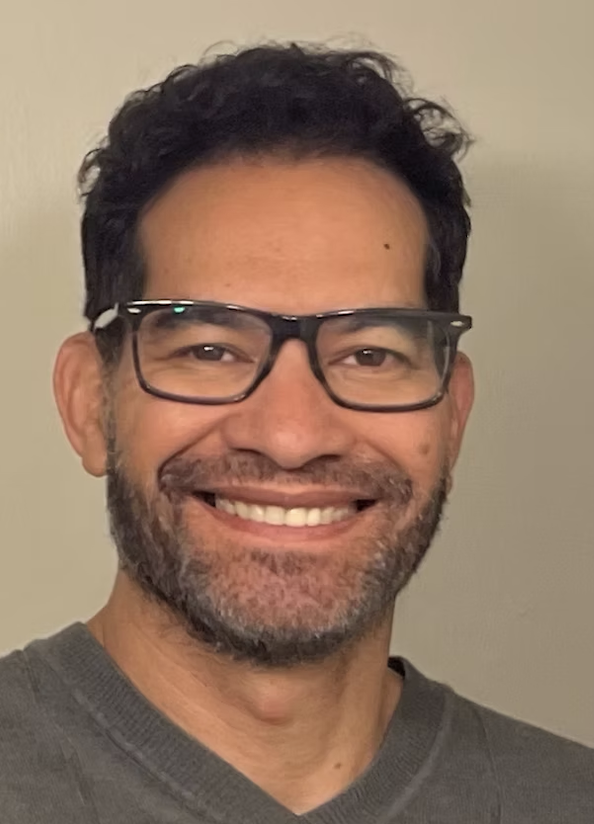
Co-Founder & Chief Scientist
Space physicist and space-systems expert with over 15 years of experience in space weather, heliophysics, and spacecraft instrumentation. Instrument scientist and technical lead on major NASA–NOAA missions including GOES-R, DSCOVR, and SWFO-L1. Expertise spanning spacecraft hardware development, on-orbit calibration, anomaly investigation, and delivery of operational space-weather products used to protect space-based assets.